

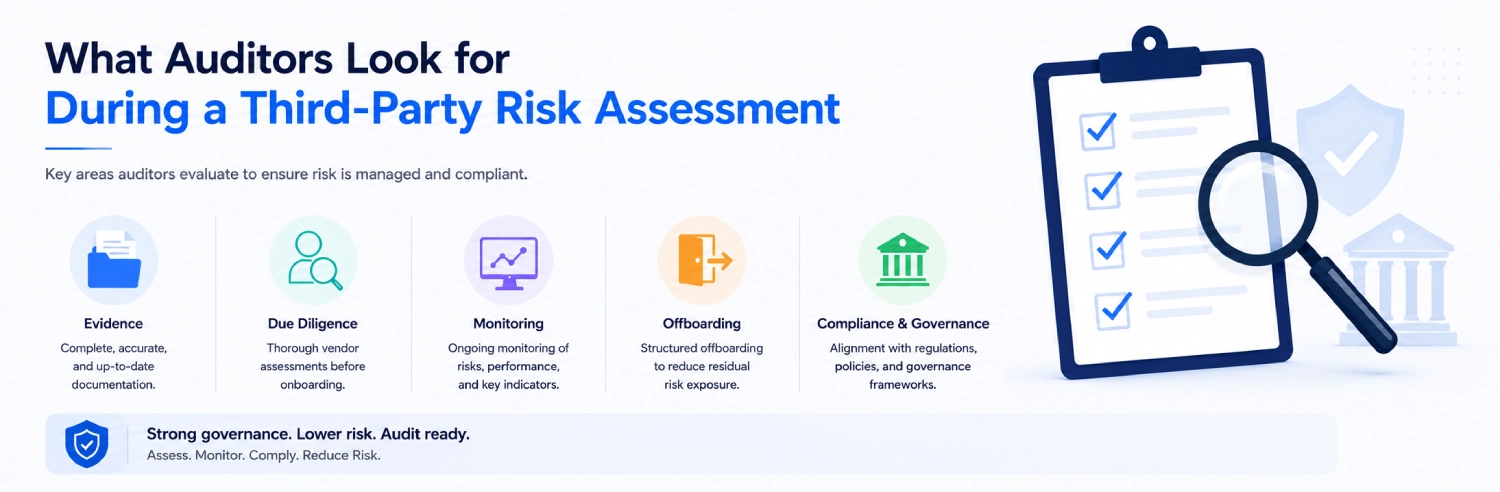
What Auditors Look for During a Third-Party Risk Assessment
An auditor arriving to examine your third-party risk program is not there to admire your questionnaire template. They are there to find out whether the program does what it claims—whether vendors are genuinely vetted, monitored, and managed throughout their lifecycle, or whether the documentation is a thin veneer over a process that runs on hope. Knowing what they look for is the difference between an audit that confirms your program and one that exposes it.
The good news is that auditors are remarkably consistent in their focus. Whether the lens is the IIA’s third-party topical requirement, a regulatory examination under RBI, SEBI, or IRDAI, or an internal review, the questions converge on the same lifecycle stages. A program that anticipates those questions and keeps the evidence current rarely has anything to fear.
Auditors Test the Process, Not Just the Paperwork
The first thing to understand is that auditors examine whether your stated process is actually followed, not merely whether it exists on paper. They will look at whether standardized onboarding and approval workflows exist, whether approvals are documented, and—critically—whether a vendor’s risk level genuinely drives how deeply it is assessed. A policy that says the right things but is inconsistently applied is, to an auditor, a finding rather than a defense.
This is why evidence matters more than intent. The question is never just ‘do you have a TPRM policy?’ but ‘show me, for this vendor, that you did what your policy requires.’ Programs that can pull that evidence on demand pass; programs that have to scramble to reconstruct it do not.
Due Diligence: Did the Depth Match the Risk?
Auditors scrutinize how vendors are vetted before approval, and whether the diligence was proportionate to the vendor’s criticality. They expect documented risk assessment through initial due diligence aligned to recognized frameworks—SIG, SOC 2, ISO 27001, or similar—and they expect the assessment to cover the risk domains relevant to what the vendor actually does.
Tiering is central to this. Auditors want to see that critical (Tier I) vendors carry full assessment documentation, continuous monitoring records, and detailed remediation trails, while lower-tier vendors receive proportionate, lighter-touch evidence such as basic screening and periodic questionnaires. A program that assesses every vendor identically—or worse, assesses critical vendors no more deeply than trivial ones—signals that risk is not really driving the work.
Continuous Monitoring: Did Anyone Keep Watching?
One of the sharpest questions an auditor asks is whether anyone monitored the vendor after onboarding. It is easy to assess a vendor once and never look again; auditors specifically test for this by checking whether periodic reassessments are scheduled and actually completed, and whether performance or risk changes trigger re-evaluation.
This is exactly where spreadsheet-based programs struggle. An auditor asking for evidence of ongoing monitoring wants to see a living record—reassessment dates met, alerts acted upon, risk changes documented—not a static sheet last updated at onboarding. Given that regulators now explicitly expect continuous oversight, the absence of monitoring evidence is among the most common and serious findings.
Contracts, Governance, and Accountability
Auditors examine vendor agreements for the provisions that make risk management enforceable: audit rights, security requirements, compliance obligations, and appropriate insurance. A contract missing the right to audit a critical vendor, or silent on security expectations, is a gap an auditor will flag because it leaves the organization without leverage when something goes wrong.
They also look upward at governance—whether ownership of third-party risk is clearly assigned, whether reporting lines reach the appropriate level of leadership, and whether the program is overseen rather than merely operated. Under the Indian regulatory frameworks especially, documented accountability is not optional; the regulated entity must show who owns the risk and how oversight is exercised.
Offboarding: The Step Everyone Forgets
The most commonly neglected stage—and therefore a favorite of auditors—is offboarding. When a vendor relationship ends, what happens to your data, their access, and the connections between your systems? Auditors check for protocols covering contract renewal, secure offboarding, and transition to new providers. A vendor that has been decommissioned on paper but still holds your data or retains live access is a textbook finding, and a real-world breach waiting to happen.
Conclusion
Auditors are predictable in the best way: they follow the vendor lifecycle from due diligence through monitoring, contracting, governance, and offboarding, and at each stage they ask to see evidence that the process was actually followed and matched to risk. The programs that sail through are not the ones with the thickest binders, but the ones that produce current, retrievable evidence at every stage as a matter of course. Build the program to be continuously audit-ready, and the audit stops being an event to dread and becomes a confirmation of work already done.
How ShieldRisk Can Help
Shieldbyte Infosec built ShieldRisk to close exactly this gap. ShieldRisk combines AI-driven vendor risk assessments, continuous external attack surface monitoring, and built-in mapping to RBI, SEBI CSCRF, IRDAI, ISO 27001, and DPDPA requirements—so your team moves from periodic, questionnaire-based checks to a living, evidence-backed view of every vendor. If you want to see where your third-party risk really sits today, we would be glad to walk you through it.