

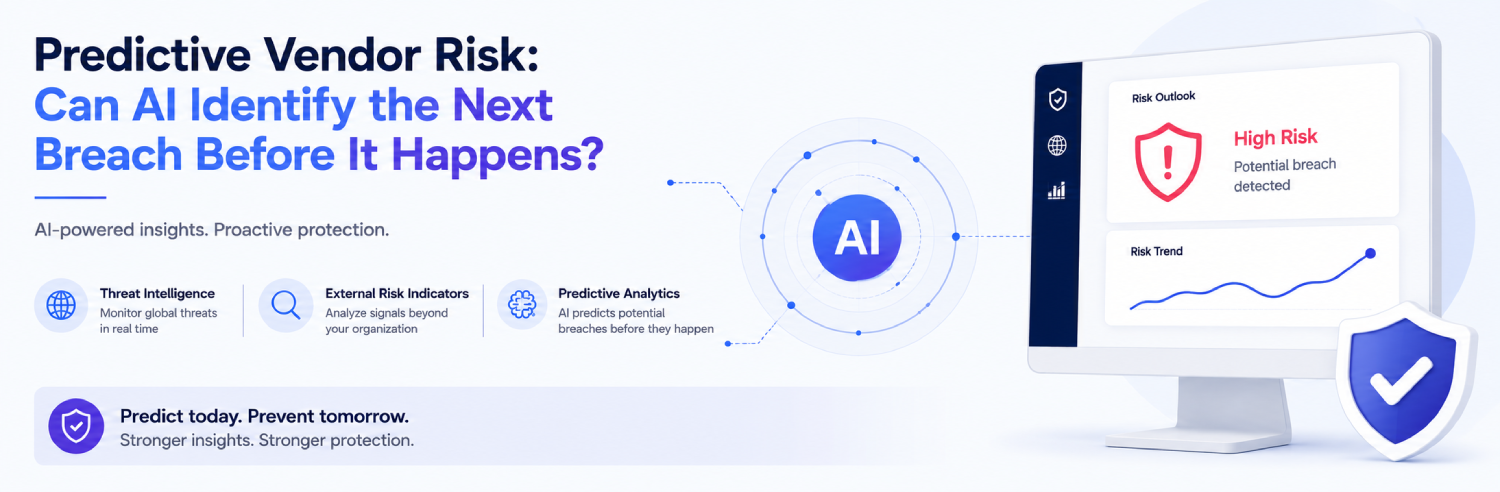
Predictive Vendor Risk: Can AI Identify the Next Breach Before It Happens?
The most expensive vendor breaches share a frustrating quality in hindsight: the warning signs were usually there. An exposed asset that lingered for weeks, leaked credentials circulating quietly, a deteriorating security posture nobody was watching. The question driving the next generation of third-party risk is whether artificial intelligence can read those signs early enough to act before the breach, rather than explaining it afterward.
The honest answer is nuanced. AI cannot foretell a specific breach on a specific date the way a weather forecast names a storm. But it can do something genuinely useful: identify which vendors are becoming more likely to suffer an incident, and flag the early indicators that historically precede one—turning vendor risk from a reactive discipline into an anticipatory one.
From Reacting to Anticipating
Traditional vendor risk is fundamentally backward-looking. An assessment captures where a vendor stood at a past moment; an incident report describes a failure that already occurred. Both are useful, but both arrive after the fact. Predictive risk flips the orientation, asking not where a vendor has been but where it appears to be heading—and how its trajectory compares to the patterns that have preceded breaches elsewhere.
This shift matters because the cost asymmetry is enormous. Catching a deteriorating vendor before an incident costs a conversation and a remediation request. Catching it after costs incident response, data loss, regulatory exposure, and reputational damage. Even a modest ability to anticipate, applied across a large portfolio, changes the economics of the whole program.
What Predictive Risk Actually Measures
Predictive risk analytics work by combining AI and machine learning with large volumes of historical and real-time data to recognize the conditions that tend to precede security incidents. Rather than a single static score, they produce continuously updated risk indicators that move as a vendor’s circumstances change. Some enterprises applying these models report threat detection accuracy approaching 96%, with substantially faster response times—evidence that the patterns are real and learnable, even if no model is infallible.
The crucial point is that these systems are looking for leading indicators, not lagging ones. They are designed to surface the early signals—anomalies, posture changes, exposure trends—that show up before an incident, so that defenders have a window in which to act rather than a post-mortem to write.
The External Signals That Precede Trouble
Much of the predictive signal comes from outside-in intelligence that requires no cooperation from the vendor at all:
1. External attack surface changes—newly exposed services, expired certificates, or misconfigurations appearing on a vendor’s internet-facing footprint.
2. Dark web and leak-site activity, such as a vendor’s credentials or data appearing for sale, which often precedes or accompanies compromise.
3. Deteriorating security posture over time, where a vendor’s continuously monitored rating trends downward across successive observations.
4. Domain, technology, and financial signals, including outdated technology stacks flagged as likely attack vectors and stress indicators that correlate with weakening security investment.
Individually, any one of these is just a data point. Combined and weighted by a model trained on how breaches actually unfold, they form an early-warning picture that a human watching a spreadsheet would almost never assemble in time.
What AI Can and Cannot Predict
It is important to be clear-eyed about the limits, because overclaiming undermines trust. AI cannot guarantee that a given vendor will be breached, name the day, or replace human judgement about what a signal means in context. What it can do is shift probabilities into view: tell you that a vendor’s risk is rising, that its indicators resemble those seen before past incidents, and that it warrants attention now rather than at the next scheduled review. Prediction here is about prioritization and early warning, not prophecy.
Turning Prediction Into Action
The value of an early warning is only realized if it drives action. In a well-designed program, predictive indicators feed directly into workflow—escalating a vendor for reassessment, triggering an outreach conversation, tightening monitoring, or informing a contract decision. The point is not to admire the model’s accuracy but to use the time it buys. A prediction that sits unread in a dashboard prevents nothing; a prediction that routes a deteriorating vendor to a human who acts on it can prevent the breach the model saw coming.
Conclusion
AI cannot predict the next breach with certainty, and any vendor claiming otherwise is overselling. But it can do something quietly transformative: read the external signals that tend to precede an incident, identify which vendors are trending toward trouble, and give defenders a window to act before rather than after. Used well—as a prioritization and early-warning engine feeding real human decisions—predictive vendor risk moves a program from cleaning up breaches to heading them off. That is not prophecy, but it may be the next best thing.
How ShieldRisk Can Help
Shieldbyte Infosec built ShieldRisk to close exactly this gap. ShieldRisk combines AI-driven vendor risk assessments, continuous external attack surface monitoring, and built-in mapping to RBI, SEBI CSCRF, IRDAI, ISO 27001, and DPDPA requirements—so your team moves from periodic, questionnaire-based checks to a living, evidence-backed view of every vendor. If you want to see where your third-party risk really sits today, we would be glad to walk you through it.