

From Excel Sheets to Intelligence: The Future of Third-Party Risk Management
Walk into most third-party risk programs and, underneath whatever process diagram hangs on the wall, you will find a spreadsheet. A master workbook with a row for every vendor, columns for assessment dates and risk ratings, and a tab or two of supporting notes. It has served faithfully for years. It is also the single biggest thing holding the program back.
This is not a knock on the people running these programs. The spreadsheet was a reasonable starting point, and for a small vendor list it can even work. The problem is that vendor ecosystems have grown, threats have accelerated, and regulators have raised expectations—while the spreadsheet has stayed exactly what it always was: a static record of things someone typed in at a moment now long past.
The Spreadsheet That Runs Your Risk Program
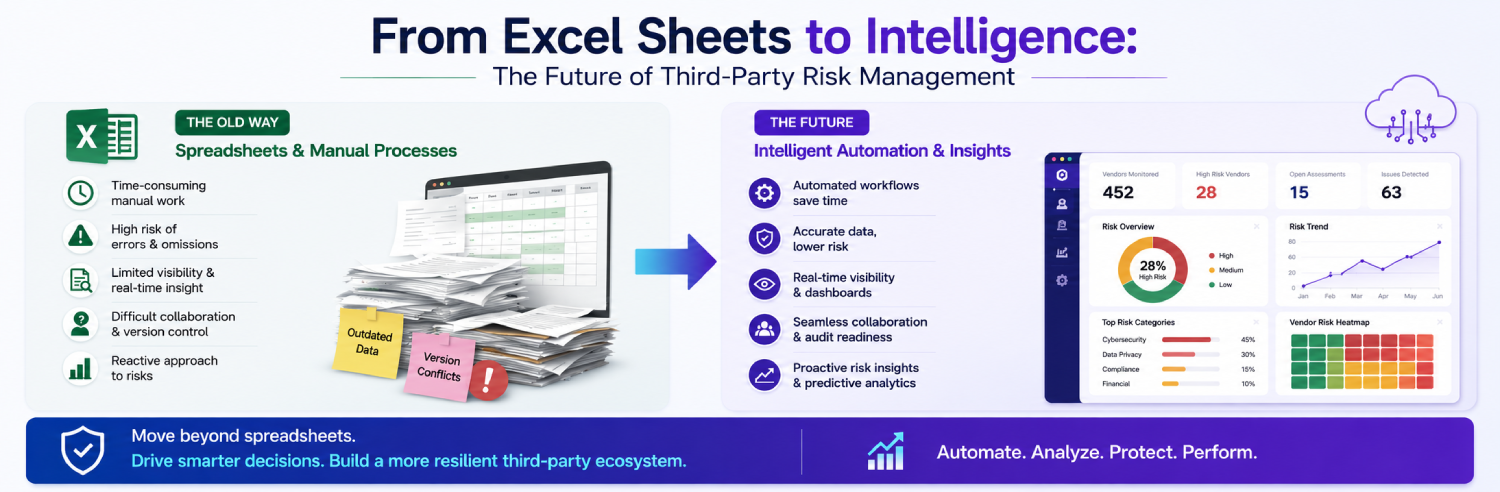
Reliance on manual tooling is the norm, not the exception. EY’s Global TPRM research has found that less than a third of organizations have run a TPRM program for more than five years, and that most still depend on manual spreadsheets and email questionnaires to track their vendors. The result is a discipline asked to manage fast-moving, high-stakes risk with tools designed for static bookkeeping.
The consequences show up in the outcomes. EY’s more recent survey found that 57% of companies cite operational disruption as their primary third-party risk—the very kind of risk that a static, periodically updated spreadsheet is least equipped to anticipate or catch in time.
Why the Spreadsheet Quietly Fails
The spreadsheet fails in ways that are easy to overlook because they are failures of omission. It is static: the moment you save it, it begins going out of date, while the vendors it describes keep changing. It is manual: every update depends on someone remembering to make it, which means coverage tracks human bandwidth rather than risk. And manual programs, constrained by that bandwidth, are estimated to monitor only 25 to 30% of their vendors effectively—leaving the majority of the portfolio as a blind spot.
It is also blind to the outside world. A spreadsheet records what a vendor reported during its last assessment. It knows nothing about the vulnerability disclosed yesterday, the breach reported this morning, or the new exposed asset the vendor stood up last week. It cannot connect signals, cannot alert anyone, and cannot tell you which vendors are trending in the wrong direction. It only knows what was typed into it.
From Static Records to Living Intelligence
The future of TPRM replaces the static record with living intelligence. Instead of a sheet that captures a moment, a modern platform maintains a continuously updated view that pulls in external attack surface data, threat and breach intelligence, and assessment results, and keeps them current automatically. The vendor’s risk profile is not retyped once a year; it updates itself as the underlying reality changes.
This is the leap from data to intelligence. A spreadsheet holds data—inert values in cells. Intelligence connects those values to live external signals, draws out what they mean, and surfaces what needs attention. The difference is the difference between a filing cabinet and an early-warning system.
Dashboards, Analytics, and the New Conversation
On top of live data sits a layer the spreadsheet could never provide: analytics and visualization. Dashboards show the state of the entire vendor portfolio at a glance, highlight the vendors that need attention, and reveal trends over time. Risk analytics turn raw signals into prioritized action, so the team spends its effort on the relationships that matter most rather than maintaining rows.
This changes the conversation with leadership and regulators. Instead of presenting a spreadsheet asserting that everyone was assessed last year, a security leader can show the current, evidenced state of the vendor ecosystem, demonstrate continuous monitoring, and answer pointed questions with live data. That is precisely the posture that RBI, SEBI, and IRDAI now expect—and precisely what a spreadsheet cannot produce.
Making the Transition
Moving off the spreadsheet does not mean discarding the discipline built around it. The vendor inventory, the risk tiers, the assessment rigor all carry forward—onto a foundation that keeps them current automatically, monitors continuously, and surfaces intelligence rather than storing data. The transition is less a rip-and-replace than a graduation: the same program, finally equipped with tools that match the speed and scale of the risk it was always meant to manage.
Conclusion
The spreadsheet has quietly become the ceiling on what most third-party risk programs can achieve. It is static where risk is dynamic, manual where scale demands automation, and blind to the external signals that now drive most breaches. The future of TPRM is not a better spreadsheet—it is a shift to living intelligence: continuously updated, externally aware, analytics-driven, and built to give leaders a current answer rather than a stale one. The organizations making that shift are not just more efficient; they are seeing risk the spreadsheet was never able to show them.
How ShieldRisk Can Help
Shieldbyte Infosec built ShieldRisk to close exactly this gap. ShieldRisk combines AI-driven vendor risk assessments, continuous external attack surface monitoring, and built-in mapping to RBI, SEBI CSCRF, IRDAI, ISO 27001, and DPDPA requirements—so your team moves from periodic, questionnaire-based checks to a living, evidence-backed view of every vendor. If you want to see where your third-party risk really sits today, we would be glad to walk you through it.