

How AI Governance and Vendor Risk Management Must Work Together
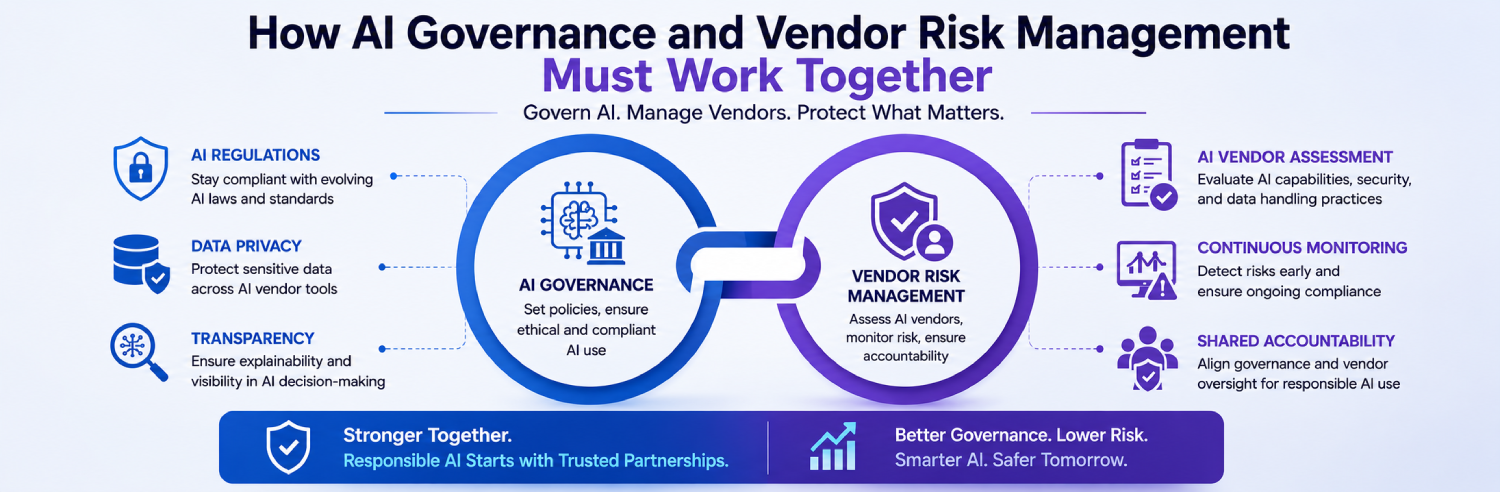
Two disciplines that grew up in separate rooms are now being forced to talk to each other. AI governance—the practice of managing how artificial intelligence is built and used responsibly—and third-party risk management have, until recently, lived in different teams with different vocabularies. The explosion of generative AI tools has collapsed the wall between them, because most of the AI an organization uses today comes from someone else.
When your employees use a third-party GenAI assistant, your AI risk and your vendor risk are the same risk. The questions of what data is being shared, how the model handles it, whether it complies with emerging AI regulation, and what happens if the provider is breached are simultaneously AI governance questions and vendor risk questions. Treating them separately leaves dangerous gaps that neither team owns.
AI Has Become a Third-Party Risk Problem
The overwhelming majority of AI capability that organizations consume is provided by external vendors—foundation model APIs, GenAI features embedded in SaaS tools, AI assistants bolted onto everyday software. Each of these is a third party that may process your data through systems you do not control and cannot fully inspect. That makes AI adoption, at its core, a vendor risk decision.
The novelty is in the nature of the exposure. Beyond the familiar concerns of any vendor, AI tools raise distinctive risks: sensitive data being absorbed into training sets, model outputs that are biased or fabricated, opacity about how decisions are reached, and a fast-moving regulatory landscape that traditional vendor questionnaires were never written to address.
Shadow AI: The Vendors No One Approved
Compounding the problem is shadow AI—employees adopting AI tools without any review by security or procurement. A team signs up for a promising assistant, pastes in real company data to get useful output, and a new, unassessed third-party data relationship is created in minutes, entirely outside the vendor register.
Gartner’s recommended response is telling, and it reads like a merger of AI governance and TPRM: enterprise-wide AI usage policies, regular audits to detect shadow AI activity, and the incorporation of GenAI risk evaluation directly into SaaS and vendor assessments. The takeaway is that you cannot govern AI without governing AI vendors, and you cannot govern vendors without accounting for the AI they introduce.
Where AI Governance and TPRM Overlap
Bring the two disciplines together and the overlap becomes obvious. Both ask who has access to your data and what they do with it. Both demand ongoing oversight rather than a one-time approval. Both require an accurate inventory of what is actually in use. And both are increasingly the subject of regulatory expectations. An AI tool slips neatly into the existing TPRM lifecycle of discovery, assessment, contracting, monitoring, and offboarding—provided the assessment step is extended to ask the AI-specific questions.
The practical implication is that organizations do not need to build an entirely separate AI risk program from scratch. They need to extend the vendor risk program they already have to recognize AI as a category with its own risk dimensions, and to evaluate AI vendors against those dimensions explicitly.
ISO 42001 and the EU AI Act Make It Concrete
Emerging standards and law are formalizing this convergence. ISO/IEC 42001:2023, the first international standard for an AI management system, explicitly includes third-party and supplier oversight among its requirements—ensuring that any externally provided input affecting AI outcomes is identified, risk-assessed, and controlled. AI governance, in other words, is written to include vendor governance.
The EU AI Act adds regulatory teeth on a phased timeline: prohibited AI practices banned from February 2025, obligations for general-purpose AI from August 2025, and full requirements for high-risk AI systems from August 2026. Organizations that deploy AI obtained from vendors increasingly need to understand and evidence those vendors’ compliance—turning AI vendor assessment from good practice into a compliance necessity.
Assessing AI Vendors Differently
Practically, assessing an AI vendor means asking questions a standard security questionnaire omits: how is our data used, and is it excluded from model training? How are bias, accuracy, and harmful outputs tested and controlled? Can the provider evidence alignment with ISO 42001 or relevant obligations under the EU AI Act? What is the human oversight model, and what happens to our data when the relationship ends? These questions sit at the intersection of AI governance and vendor risk—which is exactly why the two must be run as one.
Conclusion
AI governance and vendor risk management can no longer operate in separate rooms. The AI your organization relies on is overwhelmingly supplied by third parties, which means governing AI responsibly is inseparable from governing the vendors that provide it. Standards like ISO 42001 and laws like the EU AI Act are codifying that link, and shadow AI is making the cost of ignoring it concrete. The organizations that thrive will be those that fold AI risk into their vendor risk program—one lifecycle, one inventory, one continuous view.
How ShieldRisk Can Help
Shieldbyte Infosec built ShieldRisk to close exactly this gap. ShieldRisk combines AI-driven vendor risk assessments, continuous external attack surface monitoring, and built-in mapping to RBI, SEBI CSCRF, IRDAI, ISO 27001, and DPDPA requirements—so your team moves from periodic, questionnaire-based checks to a living, evidence-backed view of every vendor. If you want to see where your third-party risk really sits today, we would be glad to walk you through it.