
The Rise of Fourth-Party Risk: Why Your Vendor's Vendor Matters
Most vendor risk programs stop at the first layer. You assess the vendors you contract with directly, monitor their security posture, and consider the job done. But your vendors are not islands. They depend on their own suppliers—your fourth parties—who depend on theirs, and so on down a chain that extends far further than almost anyone realizes.
This deeper supply chain is where a growing share of risk now hides. When your vendor’s vendor is breached, the consequences can cascade up to you through dependencies you never mapped and could not see. Fourth-party risk is no longer an edge case for the most mature programs to worry about—it is becoming a central feature of how modern breaches actually propagate.
The Supply Chain Is Deeper Than You Think
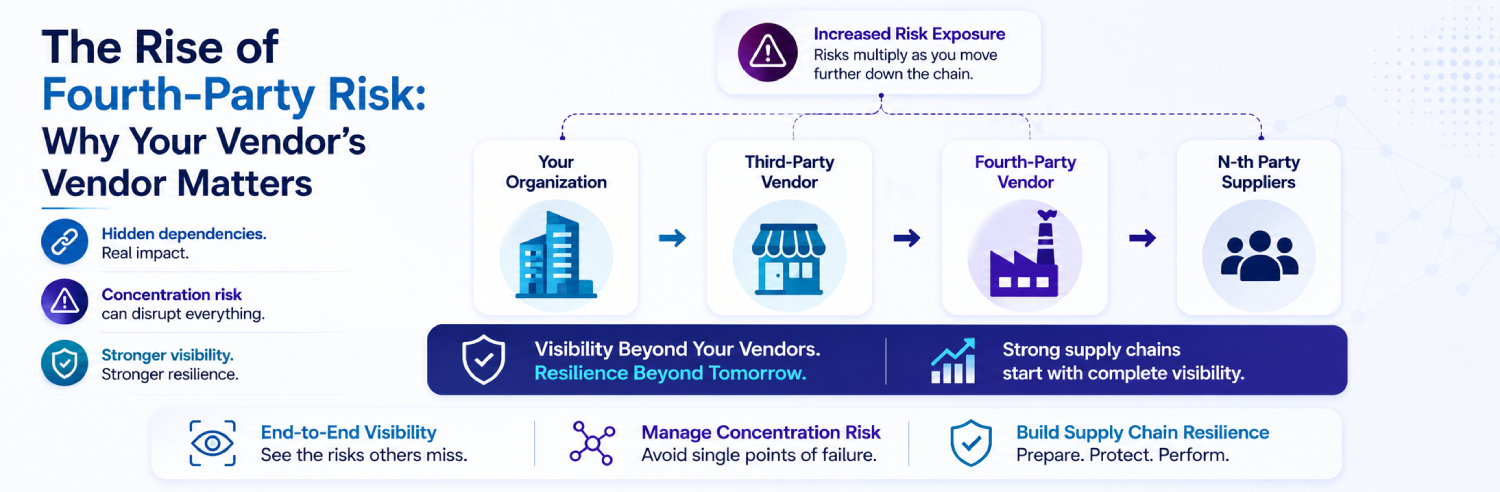
The mental model most organizations carry—me, and my vendors—badly understates reality. Every direct vendor brings with it a web of subcontractors, cloud providers, software dependencies, and service partners. Each of those has its own. The chain rarely stops at the fourth party; analyses find that the majority of supply chains reach the eighth tier and beyond.
You have no contract with these deeper parties. You may not even know their names. Yet they can process your data, support systems you rely on, or sit at a chokepoint whose failure would ripple all the way back to you. The absence of a contractual relationship does not mean the absence of risk—it means the absence of visibility into that risk.
The Numbers Behind the Hidden Tiers
The scale becomes vivid in the data. A typical organization with around 45 direct vendors sits atop roughly 328 fourth-party entities and a further 301 fifth-party organizations. For every direct vendor, in other words, there are many times more indirect dependencies operating beyond the edge of the program’s view.
And these tiers are not benign. Fourth-party breaches now account for about 4.5% of all breaches, and 12.7% of third-party breaches extend into fourth-party incidents. The risk does not stay neatly contained at the layer where it starts; it moves, and it moves toward you.
Concentration Risk: When Everyone Depends on the Same Link
Beyond the sheer depth of the chain lies a subtler danger: concentration. Concentration risk arises when many of your vendors—or many organizations across an entire sector—quietly depend on the same underlying subcontractor, cloud region, or service. On paper you have diversified across a dozen suppliers; in reality, they may all rest on a single fourth party whose failure would take them all down at once.
This is how a single outage or breach at an unseen provider can cascade into simultaneous failures across what looked like independent vendors. The diversification was an illusion, because the dependency converged one layer down where nobody was looking. Identifying these shared chokepoints is one of the most valuable things a deeper-tier view can deliver.
The Assessment Gap Nobody Talks About
Given the scale and the stakes, the response so far has been strikingly thin. Only about 10% of organizations conduct direct risk assessments of their fourth parties, and 27% do not assess or monitor them at all. Just 29% say they have any visibility into the nth parties that can access their sensitive information.
The result is a vast, largely unmonitored risk surface sitting just beyond the boundary of most programs. It is not that organizations have judged fourth-party risk and accepted it; it is that they have never seen it clearly enough to judge it at all. That gap—between how much risk lives in the deeper tiers and how little of it anyone is watching—is the real story of fourth-party risk.
Building Visibility Into the Deeper Tiers
Closing the gap does not require contracting with hundreds of unknown parties. It requires a different approach to visibility: mapping the critical dependencies behind your most important vendors, identifying where many of them converge on shared providers, and monitoring those concentration points continuously. The aim is to know, before an incident, which deeper-tier failures would actually reach you—so that the first time you learn your vendor’s vendor matters is not the day it brings your operations down.
Conclusion
Your risk does not end at the vendors you can name. It extends through hundreds of fourth and fifth parties you have never assessed, and it concentrates at shared dependencies that turn apparent diversification into hidden single points of failure. The data is clear that this deeper supply chain is where breaches increasingly originate and propagate—and equally clear that almost no one is watching it. Mapping and monitoring those deeper tiers is fast becoming the difference between a resilient supply chain and a fragile one.
How ShieldRisk Can Help
Shieldbyte Infosec built ShieldRisk to close exactly this gap. ShieldRisk combines AI-driven vendor risk assessments, continuous external attack surface monitoring, and built-in mapping to RBI, SEBI CSCRF, IRDAI, ISO 27001, and DPDPA requirements—so your team moves from periodic, questionnaire-based checks to a living, evidence-backed view of every vendor. If you want to see where your third-party risk really sits today, we would be glad to walk you through it.