

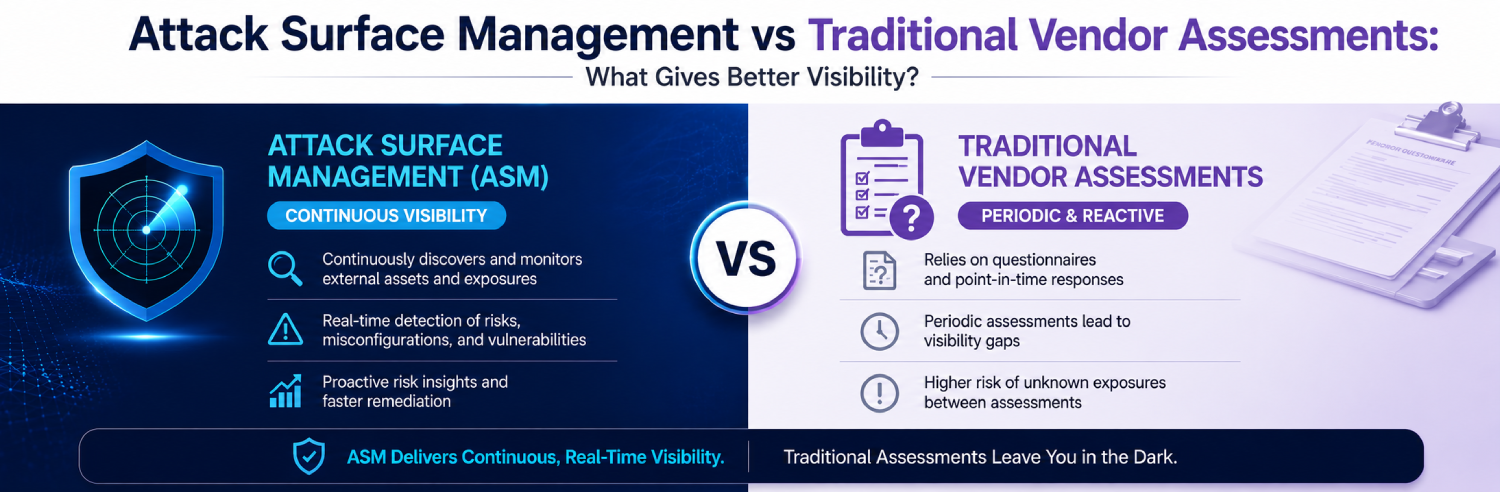
Attack Surface Management vs Traditional Vendor Assessments: What Gives Better Visibility?
There are two fundamentally different ways to find out how secure a vendor is. You can ask them, or you can look. The questionnaire-based assessment asks; attack surface management looks. Both have a place, but they answer different questions, and confusing one for the other is how organizations end up confident and exposed at the same time.
The distinction is not academic. As supply chain attacks rise and regulators demand continuous oversight, the difference between what a vendor says about its security and what its security actually looks like from the outside has become one of the most important gaps a risk program has to close.
Two Very Different Questions
A traditional vendor assessment asks a vendor to describe its own controls: do you encrypt data at rest, do you enforce multi-factor authentication, how often do you patch? The answers are self-reported, point-in-time, and only as accurate as the respondent’s honesty and knowledge. Attack surface management asks a different question entirely—not what the vendor claims, but what an attacker scanning the internet can actually see of the vendor’s exposed systems right now.
One is an interview; the other is an observation. An interview captures intent and policy. An observation captures reality. The most dangerous risks tend to live in the space between the two—where a vendor genuinely believes it is secure, but a forgotten server, an expired certificate, or a misconfigured cloud bucket says otherwise.
From Weeks to Hours: Automating Evidence Analysis
The clearest gains come from evidence analysis. AI-driven platforms can ingest a lengthy SOC 2 report, ISO 27001 certificate, or completed questionnaire and summarize the security-relevant content in moments—surfacing exceptions, missing controls, and inconsistencies that a human reviewer might take hours to find. Industry analyses describe assessment time falling from weeks to hours when this analysis is automated.
This does more than save time. Machines read every page with the same diligence on the hundredth report as the first, which removes the fatigue-driven inconsistency that creeps into any large manual review. The analyst is handed a structured summary and a set of flagged issues, and starts from a position of clarity rather than a pile of PDFs.
What the Questionnaire Tells You—and What It Misses
Questionnaires remain valuable. They are the only practical way to learn about internal practices that leave no external footprint—governance, employee training, incident response procedures, data handling policies. No external scan can tell you whether a vendor runs tabletop exercises or how it manages privileged access internally.
But questionnaires have well-known blind spots. They are self-reported, so they reflect what the vendor believes or wants you to believe. They are point-in-time, capturing one moment that may be obsolete weeks later. And they say nothing about the assets the vendor has forgotten it owns—the shadow IT and abandoned infrastructure that never make it onto any internal inventory, and therefore never make it into an honest answer.
What Attack Surface Management Actually Sees
Attack surface management continuously discovers and monitors a vendor’s internet-facing assets from the outside, exactly as an attacker would. It surfaces the exposures that questionnaires cannot: misconfigured cloud storage with public access, forgotten subdomains hosting login pages without multi-factor authentication, exposed admin portals, expired or weak certificates, and unpatched edge devices.
Crucially, ASM is continuous rather than periodic. It does not wait for the next assessment cycle to notice that a vendor stood up a vulnerable service last week. It sees the change when it happens, which matters enormously given that attackers move from disclosure to exploitation in as little as 24 to 48 hours.
The Visibility Gap, in Numbers
The scale of what gets missed is striking. Research from ESG indicates that nearly 70% of organizations have experienced a cyberattack through an unknown, unmanaged, or poorly managed internet-facing asset, and 76% reported an attack tied to an exposed asset in 2024. Roughly 87% of incidents now span two or more surfaces. These are, almost by definition, exposures a questionnaire would never have captured, because nobody knew the asset existed to ask about it.
This is the heart of the matter. The vendor cannot tell you about a risk it does not know it has. Only an outside-in view—looking at the vendor the way an attacker does—reliably surfaces the unknown, unmanaged exposure that causes so many breaches.
Why the Answer Is Both, Not Either
The right conclusion is not that ASM replaces the questionnaire. It is that the two are complementary halves of a complete picture. The questionnaire reveals internal practices and intent that no scan can see; ASM reveals external reality that no self-report will admit. Used together, they let you compare what a vendor says against what its exposure actually shows—and pay particular attention when the two diverge. A program that relies on questionnaires alone is trusting claims it cannot verify; a program that combines both is verifying them.
Conclusion
Questionnaires and attack surface management answer different questions, and a mature vendor risk program needs both answers. Asking the vendor tells you what it intends and how it governs itself. Looking at the vendor tells you what an attacker can actually reach. The visibility that prevents breaches comes from holding the two side by side—because the most dangerous vendor risk usually lives in the gap between what was claimed and what is true.