

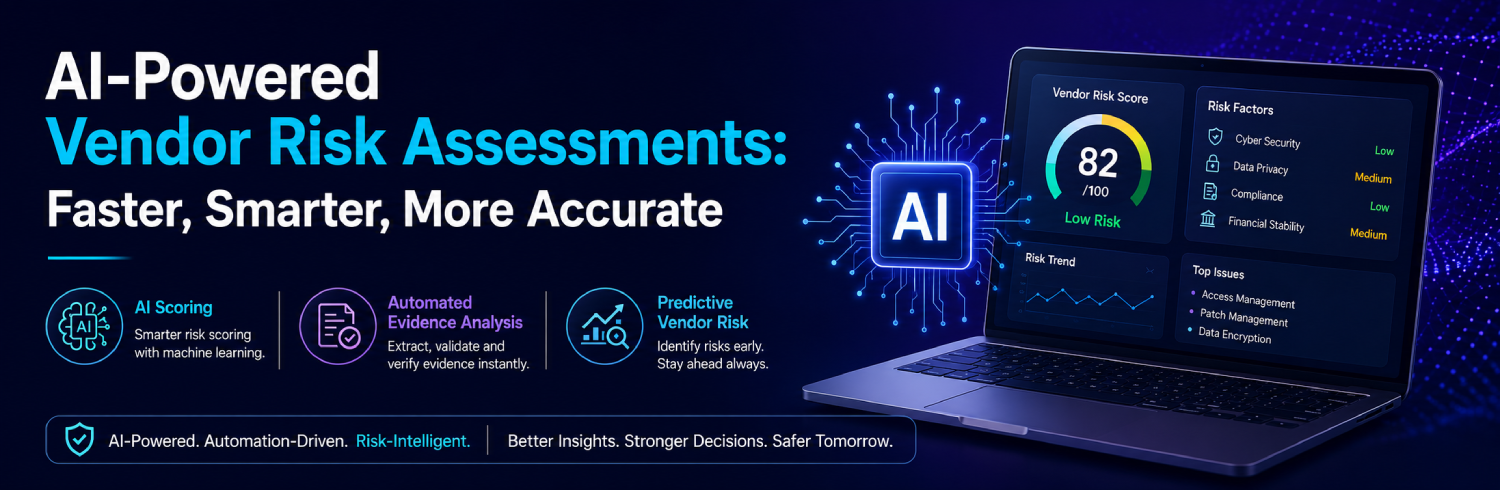
AI-Powered Vendor Risk Assessments: Faster, Smarter, More Accurate
Ask anyone who runs a third-party risk program where the time goes, and the answer is rarely the interesting part. It is not the judgement calls or the risk decisions. It is the grind: chasing vendors for documents, reading hundred-page SOC 2 reports, transcribing answers into spreadsheets, and reconciling evidence that arrives in a dozen formats. This manual overhead is precisely where artificial intelligence is now making the largest difference.
The promise of AI in vendor risk is often oversold as a magic risk oracle. The reality is more grounded and, arguably, more valuable: AI removes the bottlenecks that have kept TPRM slow, shallow, and inconsistent—freeing skilled analysts to spend their time on the decisions that actually require judgement.
The Bottleneck Was Never the Vendors
The traditional assessment process is slow not because vendors are uncooperative, but because the work is fundamentally manual. A single thorough review can take weeks of back-and-forth, document collection, and line-by-line analysis. Multiply that by a vendor portfolio in the hundreds and the math becomes impossible—which is exactly why so many organizations quietly assess only a fraction of their vendors and reassess them only once a year.
AI attacks this bottleneck directly. By automating the reading, extraction, and cross-referencing of vendor evidence, it compresses work that consumed weeks into a matter of hours, and makes it feasible to cover the whole portfolio rather than a chosen few.
From Weeks to Hours: Automating Evidence Analysis
The clearest gains come from evidence analysis. AI-driven platforms can ingest a lengthy SOC 2 report, ISO 27001 certificate, or completed questionnaire and summarize the security-relevant content in moments—surfacing exceptions, missing controls, and inconsistencies that a human reviewer might take hours to find. Industry analyses describe assessment time falling from weeks to hours when this analysis is automated.
This does more than save time. Machines read every page with the same diligence on the hundredth report as the first, which removes the fatigue-driven inconsistency that creeps into any large manual review. The analyst is handed a structured summary and a set of flagged issues, and starts from a position of clarity rather than a pile of PDFs.
From 30% to 90%: Closing the Coverage Gap
Perhaps the most consequential effect is on coverage. Manual programs are estimated to monitor only 25 to 30% of their vendors effectively, simply because there are not enough hours to go around. AI-driven platforms push effective coverage above 90%, because the marginal cost of assessing one more vendor collapses when the analysis is automated.
Coverage is not a vanity metric. The vendor you never got around to assessing is, by definition, the one whose risk you cannot see—and attackers are happy to find the gap you left. Lifting coverage from a third of the portfolio to nearly all of it changes the risk picture fundamentally, turning blind spots into monitored relationships.
Smarter Scoring and Dynamic Questionnaires
AI also makes the assessment itself more intelligent. Rather than sending every vendor the same generic questionnaire, AI can dynamically route the right questions based on a vendor’s risk profile and the services it provides—asking a payment processor about transaction security and a marketing tool about data handling, instead of burying both under irrelevant questions.
On top of that, AI scoring synthesizes signals from questionnaire responses, external attack surface data, and threat intelligence into a coherent, continuously updated risk score. Because the inputs refresh on their own, the score reflects the vendor’s current state rather than a stale snapshot from the last review cycle.
Keeping Humans in the Loop
None of this removes the need for human judgement, and a well-designed program does not pretend otherwise. AI is exceptional at reading, extracting, summarizing, and flagging at scale; it is not the right authority for deciding whether a flagged risk is acceptable given a specific business context, contract, or compensating control. The most effective model pairs the two—machines handling the volume, people making the calls—so that scarce expert attention lands on the issues that genuinely need it.
Conclusion
AI does not replace the judgement at the heart of third-party risk management; it removes the manual drudgery that has kept that judgement from being applied broadly and consistently. By collapsing assessment time from weeks to hours and lifting coverage from a fraction of vendors to nearly all of them, AI lets a program finally match the scale and speed of the risk it is meant to manage. The organizations adopting it are not assessing less carefully—they are assessing far more, far faster, with people focused where they add the most value.