

The Hidden Cyber Risks Lurking in Your Critical Vendors
Every organization keeps a short list of vendors it cannot operate without: the payroll processor, the cloud provider, the core banking platform, the managed IT partner. These are the relationships built on years of trust. They are also, precisely because of the access and integration that trust enables, the place where the most dangerous cyber risk now hides.
The uncomfortable truth is that your strongest vendor relationships often carry your weakest visibility. You know what these partners do for you. You rarely know, in any current detail, how exposed they are, who their own suppliers are, or what would happen to your data and operations if they were compromised tomorrow.
The Vendors You Trust Most Are Your Largest Attack Surface
Criticality and risk are two sides of the same coin. The vendors that matter most are the ones granted the deepest access—to your networks, your customer data, your transaction flows. That access is exactly what an attacker wants. Compromising a peripheral supplier yields little; compromising the partner wired into your core systems yields everything.
This is why attackers have shifted their attention to the supply chain. Verizon’s 2025 Data Breach Investigations Report found that third-party involvement in breaches doubled to 30%. The path of least resistance increasingly runs through a trusted intermediary rather than your own perimeter, because that intermediary has already been let inside.
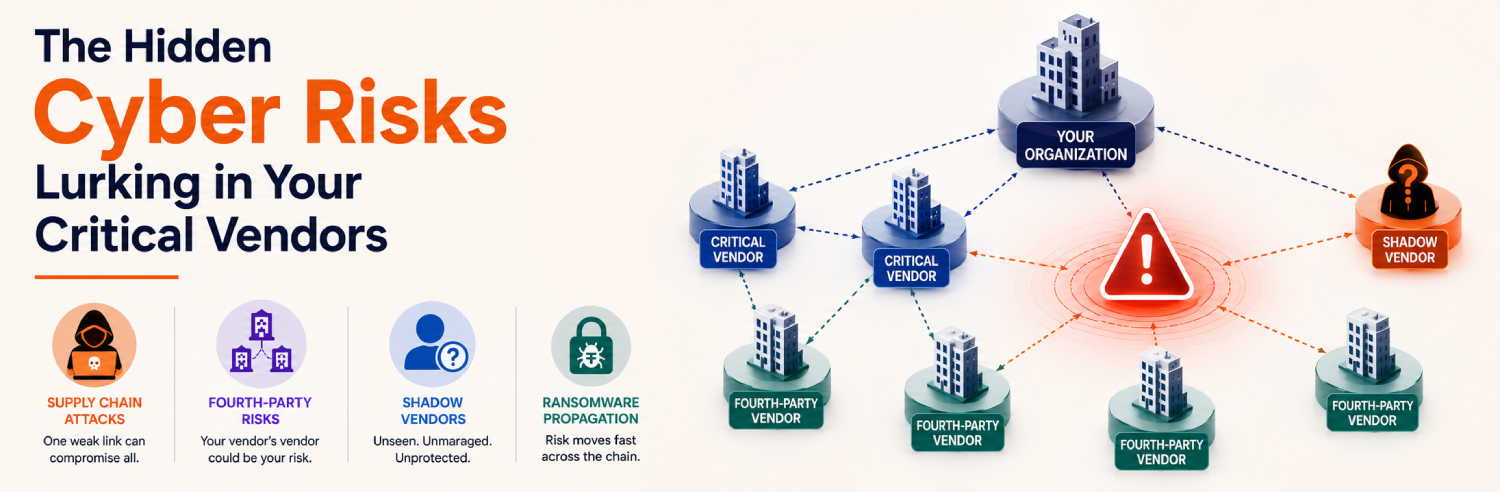
Supply Chain Attacks: One Compromise, Many Victims
A supply chain attack is efficient in a way that frightens defenders: the attacker compromises one supplier and inherits access to every customer that supplier serves. A single poisoned software update, a single breached managed service provider, can cascade into hundreds of downstream victims who did nothing wrong themselves.
The economics favor the attacker overwhelmingly. Why mount hundreds of separate intrusions when one well-chosen target multiplies the payoff? For the defender, this means a vendor’s security failures are no longer the vendor’s problem alone—they are your incident, your data loss, and your regulatory exposure, arriving through a door you did not know was unlocked.
Fourth Parties and Shadow Vendors: The Risk You Cannot See
The visibility problem deepens one layer down. Your vendors have vendors—fourth parties—and those have vendors in turn. Research suggests a typical organization with around 45 direct vendors sits atop roughly 328 fourth parties and 301 fifth parties, with most supply chains reaching the eighth tier and beyond. Yet only about 10% of organizations directly assess their fourth parties, and over a quarter do not assess them at all.
Alongside this sit shadow vendors: tools and services adopted by individual teams without going through procurement or security review. The marketing SaaS bought on a card, the AI assistant signed up for during a trial, the file-sharing app a department finds convenient. Each one may handle company data, and none of them appears in the vendor register the security team is monitoring.
The common thread across fourth parties and shadow vendors is the same: risk you have not catalogued is risk you cannot manage. You cannot patch, monitor, or contractually control a relationship you do not know exists.
How Ransomware Propagates Through the Supply Chain
Ransomware has made the cost of these blind spots concrete. Ransomware is now present in 44% of breaches, up 37% year over year, and it does not respect organizational boundaries. When a managed service provider is hit, the malware frequently spreads through the very remote-management tooling that provider uses to support its clients—turning a trusted maintenance channel into a distribution network for the attack.
This is what makes ransomware in the supply chain so corrosive. The infrastructure designed to make a vendor relationship convenient—shared access, standing connections, automated deployment—is the same infrastructure that lets an attack jump from the vendor to you, often faster than either side can respond.
Surfacing the Hidden Risk
The defense begins with seeing what you currently cannot. That means building and maintaining an accurate inventory of vendors and, critically, the fourth parties they depend on; monitoring those relationships continuously from the outside in; and prioritizing attention on the concentrated dependencies where many of your critical functions quietly rest on the same underlying supplier. The goal is not to eliminate trust but to make it evidence-based rather than assumed.
Conclusion
The cyber risks that threaten you most are rarely the ones in plain sight. They live in the trusted vendor whose own posture has slipped, in the fourth party you never mapped, in the shadow tool a team adopted last quarter, in the managed provider whose breach becomes your breach. Visibility is the whole game. You cannot defend an attack surface you have never seen—and for most organizations, the largest unseen surface belongs to someone else.
How ShieldRisk Can Help
Shieldbyte Infosec built ShieldRisk to close exactly this gap. ShieldRisk combines AI-driven vendor risk assessments, continuous external attack surface monitoring, and built-in mapping to RBI, SEBI CSCRF, IRDAI, ISO 27001, and DPDPA requirements—so your team moves from periodic, questionnaire-based checks to a living, evidence-backed view of every vendor. If you want to see where your third-party risk really sits today, we would be glad to walk you through it.