

Why Third-Party Risk Management Is No Longer an Annual Exercise
For most organizations, third-party risk management still runs on a calendar. Once a year, the security or procurement team sends out a questionnaire, collects a stack of responses, scores the answers, files the report, and moves on. It feels orderly. It satisfies the auditor. And it is increasingly disconnected from how risk actually behaves in 2026.
The problem is simple. A vendor’s risk posture is not a fixed property you can measure once and trust for twelve months. It changes the day they spin up a new cloud service, the week a critical vulnerability is disclosed in software they run, the moment one of their own suppliers is breached. An annual assessment captures a single frame of a film that never stops playing—and then asks you to make decisions as if the frame were the whole story.
The Annual Snapshot Was Always a Compromise
The yearly review became standard not because it was the right cadence, but because it was the only one that was practical with the tools available. Questionnaires are slow to send, slow to complete, and slow to score. Doing that work for dozens or hundreds of vendors more than once a year was simply too expensive in terms of human time, so once a year became the default.
That compromise made sense when the threat moved slowly. It does not hold up now. Attackers exploit newly disclosed vulnerabilities within 24 to 48 hours of public disclosure, while the average organization still measures its vendor reassessment cycle in months. By the time your annual review flags a problem, the window in which that problem could have been exploited has long since opened and closed.
The Risk Numbers Have Moved Against You
The case for continuous monitoring is not theoretical. According to Verizon’s 2025 Data Breach Investigations Report, third-party involvement in breaches doubled to 30%—up from 15% the year before. Roughly one in three breaches now reaches the victim through a partner, supplier, or service provider. At the same time, exploitation of vulnerabilities as an initial access vector rose 34%, and attacks against edge and VPN devices jumped from 3% to 22% of breaches in a single year.
Put together, these trends describe an environment where the vendor you assessed as low-risk in January can become your most dangerous exposure by June, without anything changing on your own network. The risk arrived through someone else’s infrastructure, on a timeline your annual cycle was never designed to catch.
What Continuous TPRM Actually Means
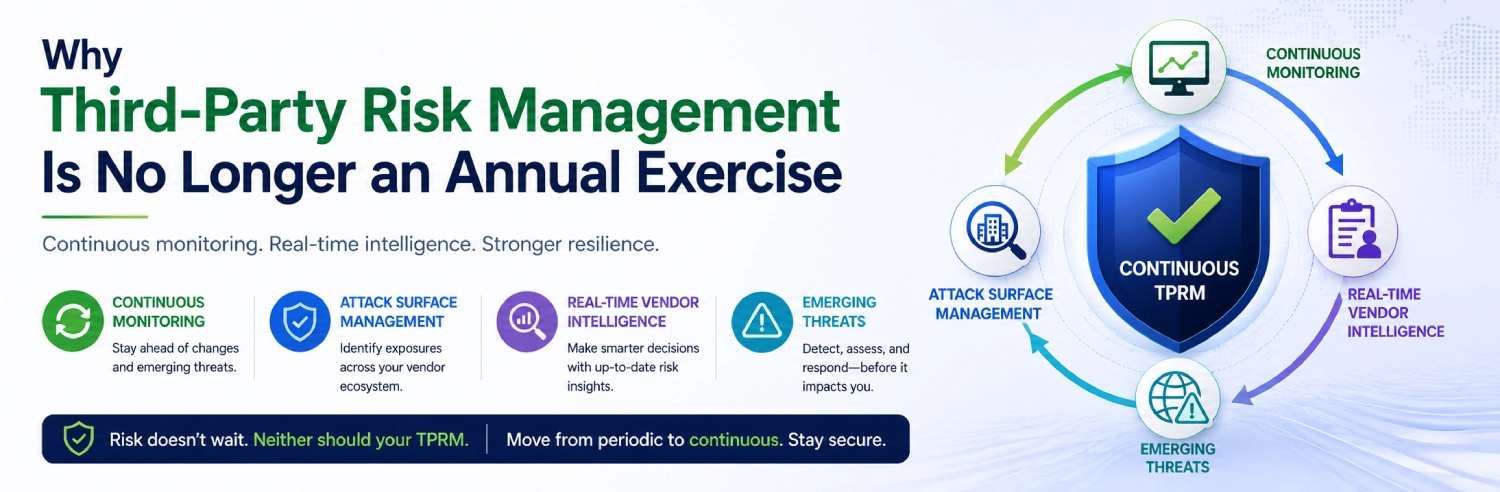
Continuous third-party risk management does not mean sending questionnaires every week. It means combining the point-in-time judgement of an assessment with always-on, outside-in signals that update on their own. Instead of asking a vendor once whether they patch promptly, you observe whether their internet-facing systems actually carry known, unpatched vulnerabilities—today, and again tomorrow.
In practice, a continuous program brings together a few distinct streams of evidence:
1. Attack surface monitoring that discovers and watches a vendor’s externally exposed assets, flagging exposed admin portals, expired certificates, and misconfigured cloud storage as they appear.
2. Threat and breach intelligence that alerts you when a vendor is named in a disclosed incident, appears on a leak site, or shows credentials circulating on the dark web.
3. Periodic, risk-tiered assessments that go deep on your most critical vendors and stay lighter-touch on the rest, so human effort is spent where it matters.
The result is a posture that reacts to events rather than waiting for the next scheduled review. When a vendor’s exposure changes, the program notices and routes it to a human to decide what to do.
Why Real-Time Vendor Intelligence Changes the Conversation
There is a strategic dividend here that goes beyond catching problems faster. When risk data is current, the conversation with leadership and regulators changes in character. Instead of reporting that every vendor passed last year’s review, you can show the live state of your vendor ecosystem, identify which suppliers are trending in the wrong direction, and demonstrate that monitoring is genuinely ongoing rather than a once-a-year ritual.
That distinction matters under tightening regulation. Indian supervisors, from the RBI to SEBI and IRDAI, now expect regulated entities to maintain continuous oversight of outsourced and third-party arrangements—not a single annual sign-off. A program built around real-time intelligence answers that expectation by design, rather than scrambling to reconstruct evidence at audit time.
Conclusion
The annual vendor review is not worthless, but it has quietly become a snapshot of a moving target. Risk now enters through third parties more often than ever, and it moves faster than any yearly cycle can track. The organizations that handle this well are not the ones with the thickest questionnaires; they are the ones that have made vendor risk a live signal rather than a filed document. Moving from periodic to continuous is no longer an advanced capability—it is becoming the baseline expectation.
How ShieldRisk Can Help
Shieldbyte Infosec built ShieldRisk to close exactly this gap. ShieldRisk combines AI-driven vendor risk assessments, continuous external attack surface monitoring, and built-in mapping to RBI, SEBI CSCRF, IRDAI, ISO 27001, and DPDPA requirements—so your team moves from periodic, questionnaire-based checks to a living, evidence-backed view of every vendor. If you want to see where your third-party risk really sits today, we would be glad to walk you through it.